Kanzeon Lineage
From Shakyamuni Buddha, through more than eighty generations of ancestors, the living Dharma has been transmitted heart to heart and mind to mind. That same stream flows West through Maezumi Roshi to Genpo Roshi — the 81st ancestor in the lineage — where three currents of Zen converge and continue today as the Big Mind Big Heart Way.
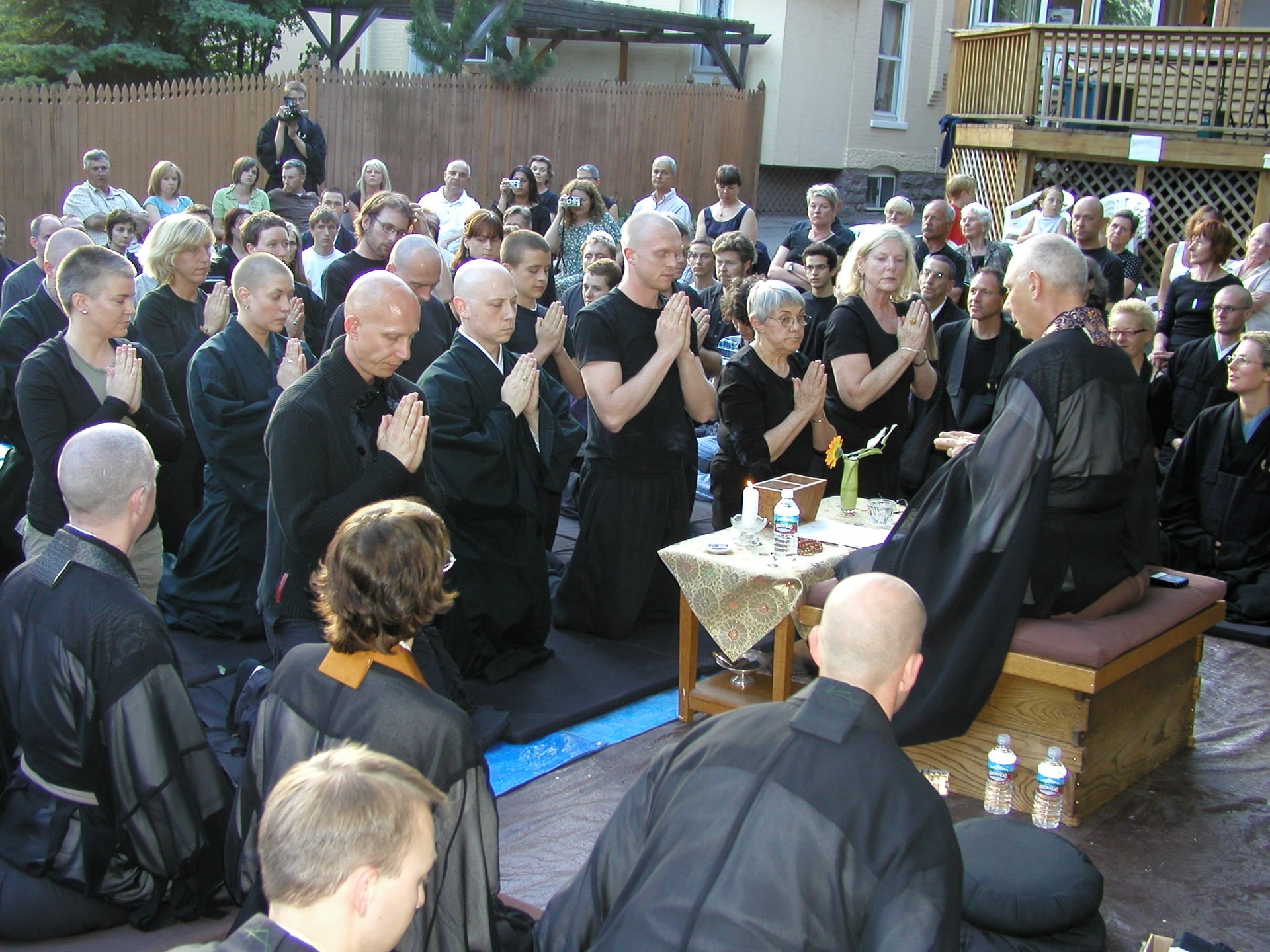
Dharma Motto
One Mind One Heart
Awakening to our true nature and embodying wisdom and compassion for the benefit of all beings.
Temple Invocation
In the great stream of awakening flowing from Gautama Buddha, through more than eighty generations of Zen Patriarchs, the living Dharma continues to unfold in each moment.
This Way has been transmitted heart-to-heart and mind-to-mind from master to successor, continuing through the Japanese Zen lineage that came to the West through the lineage of Baian Hakujun Kuroda Daiōshō and his son, Koun Taizan Maezumi Roshi, who brought the depth of this Zen tradition to the West.
Today, this living transmission continues through Soten Genpo Merzel Roshi, one of the 81st Patriarchs in the lineage descending from the Buddha, expressing the ancient Dharma through the integration of Big Mind Big Heart.
Within this living stream of Dharma, the Kanzeon Big Heart Way expresses the unity of Awakened Wisdom and Boundless Compassion. The Awakened Mind and the Compassionate Heart are realized as one living reality, manifesting as wisdom, love, and service for the liberation of all beings.
Lineage: The Convergence of 3 Zen Streams
The Kanzeon lineage also reflects a rare meeting of streams within the Zen tradition.
The Zen Buddha Dharma brought to the West by Taizan Maezumi Roshi represents the meeting of 3 important streams within modern Japanese Buddhism.
This path continues through the Zen lineage transmitted to Soten Genpo Merzel, the 81st ancestor in the lineage descending from the Buddha Shakyamuni.
Sōten Genpo Daiōshō, Roshi, carries forward this living transmission and expresses it through the integration of traditional Zen practice with the modern methods of Big Mind Big Heart Way.
In this way, the ancient stream of awakening continues to flow. Alive in this moment and dedicated to the liberation and well-being of all beings.
The Soto Zen Lineage
This tradition emphasizes zazen and the practice of shikantaza — “just sitting” — where awakening is expressed through wholehearted presence in every aspect of daily life as practice realization.
Kōun Taizan Maezumi Daiōshō Roshi inherited Sōtō Zen Dharma transmission through his father, Baian Hakujun Kuroda Roshi (1898–1978).
Dennis Genpo Merzel, later known as Sōten Genpo Daiōshō, received Dharma transmission from Kōun Taizan Maezumi Daiōshō and continued this lineage in the West. He later received Inka from Bernie Tetsugen Glassman Daiōshō, his elder brother and teacher, further affirming his place within the living Zen tradition.
The Joko–Kopryu Rinzai Stream
Maezumi Roshi also received Inka Shōmei in the Rinzai tradition from Koryū Osaka, a distinguished Rinzai Zen lay master known for his deep realization and independent spirit.
Koryu Osaka Roshi studied with Muso Jōkō Roshi (1884–1949), founder of the Shakamuni-kai lay Buddhist movement and a practitioner of the Shingon tradition, and Kōryū Osaka Roshi (1901–1985), a well-respected Rinzai Zen master who was asked by his teacher Muso Joko Roshi to remain a layperson and not be ordained as a priest.
After completing koan study with Yasutani Roshi, Maezumi Roshi continued working with Kōryū Roshi.
In March 1972, Kōryū Osaka Roshi granted Inka, formally recognizing Maezumi Roshi’s realization within the Lay Rinzai tradition.
That same week marked Genpo Roshi’s first week practicing with both Maezumi Roshi and Kōryū Osaka Roshi.
Maezumi Roshi held deep respect for Gempō Yamamoto, the Dharma Master of Koryū Osaka Roshi. In recognition of this connection, he gave his student Dennis Merzel the Dharma name Genpo, linking the Kanzeon lineage symbolically to that Rinzai stream.
From Taizan Maezumi Roshi, Inka flowed to Bernie Tetsugen Glassman Roshi (1939–2018), founder of the Zen Peacemaker Order, and through him to Dennis Genpo Merzel.
The Harada–Yasutani Koan Stream
This lineage integrated Sōtō Zazen with Rinzai-style koan inquiry.
This stream came through Harada Daiun Sogaku Roshi (1871–1961) and Hakuun Yasutani Roshi (1885–1973).
Maezumi Roshi completed his koan training with Yasutani Roshi in the late 1960s.
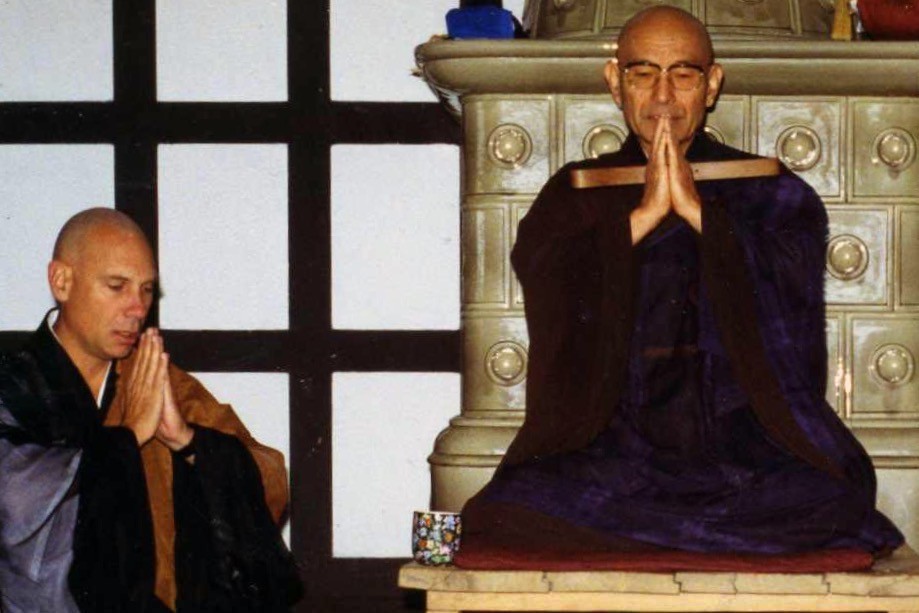
Continuation into Big Mind · Big Heart
The Emergence of Big Mind Big Heart
Through these interwoven transmissions, the Kanzeon lineage reflects the meeting of the Sōtō and Rinzai streams of Zen, as expressed today in the practice and teaching of the Big Mind Big Heart Way.
This skillful means allows true practitioners to directly experience different perspectives within consciousness, including the voice known as Big Mind or One Mind—the boundless awareness beyond the conceptual, separate self.
From this realization naturally and spontaneously emerges Big Heart, the unconditional, compassionate functioning of awakened awareness in everyday life.
Big Mind Big Heart can therefore be understood as a contemporary skillful means that reveals the same awakened nature that Zen has always pointed toward.
Allowing one to express the living union of Big Mind Big Heart for the benefit of all beings.
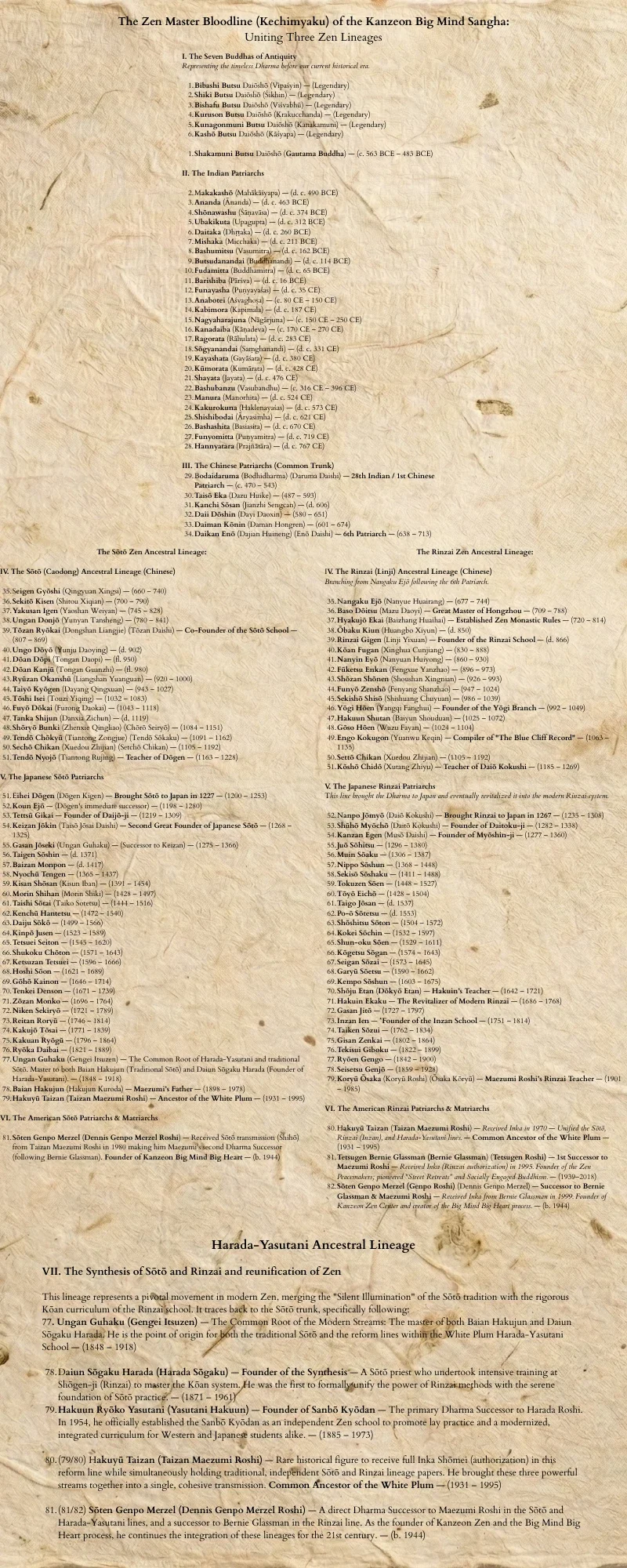
The Zen Master Bloodline (Kechimyaku) of the Kanzeon Big Mind Sangha
Uniting Three Zen Lineages
I. The Seven Buddhas of Antiquity
Representing the timeless Dharma before our current historical era.
1. Bibashi Butsu Daiōshō (Vipaśyin) — (Legendary)
2. Shiki Butsu Daiōshō (Śikhin) — (Legendary)
3. Bishafu Butsu Daiōshō (Viśvabhū) — (Legendary)
4. Kuruson Butsu Daiōshō (Krakucchanda) — (Legendary)
5. Kunagonmuni Butsu Daiōshō (Kanakamuni) — (Legendary)
6. Kashō Butsu Daiōshō (Kāśyapa) — (Legendary)
1. Shakamuni Butsu Daiōshō (Gautama Buddha) — (c. 563 BCE – 483 BCE)
II. The Indian Patriarchs
2. Makakashō (Mahākāśyapa) — (d. c. 490 BCE)
3. Ananda (Ānanda) — (d. c. 463 BCE)
4. Shōnawashu (Śāṇavāsa) — (d. c. 374 BCE)
5. Ubakikuta (Upagupta) — (d. c. 312 BCE)
6. Daitaka (Dhītaka) — (d. c. 260 BCE)
7. Mishaka (Micchaka) — (d. c. 211 BCE)
8. Bashumitsu (Vasumitra) — (d. c. 162 BCE)
9. Butsudanandai (Buddhanandi) — (d. c. 114 BCE)
10. Fudamitta (Buddhamitra) — (d. c. 65 BCE)
11. Barishiba (Pārśva) — (d. c. 16 BCE)
12. Funayasha (Puṇyayaśas) — (d. c. 35 CE)
13. Anabotei (Aśvaghoṣa) — (c. 80 CE – 150 CE)
14. Kabimora (Kapimala) — (d. c. 187 CE)
15. Nagyaharajuna (Nāgārjuna) — (c. 150 CE – 250 CE)
16. Kanadaiba (Kāṇadeva) — (c. 170 CE – 270 CE)
17. Ragorata (Rāhulata) — (d. c. 283 CE)
18. Sōgyanandai (Saṃghanandi) — (d. c. 331 CE)
19. Kayashata (Gayāśata) — (d. c. 380 CE)
20. Kūmorata (Kumārata) — (d. c. 428 CE)
21. Shayata (Jayata) — (d. c. 476 CE)
22. Bashubanzu (Vasubandhu) — (c. 316 CE – 396 CE)
23. Manura (Manorhita) — (d. c. 524 CE)
24. Kakurokuna (Haklenayaśas) — (d. c. 573 CE)
25. Shishibodai (Āryasiṃha) — (d. c. 621 CE)
26. Bashashita (Basiasita) — (d. c. 670 CE)
27. Funyomitta (Puṇyamitra) — (d. c. 719 CE)
28. Hannyatara (Prajñātāra) — (d. c. 767 CE)
III. The Chinese Patriarchs (Common Trunk)
29. Bodaidaruma (Bodhidharma) (Daruma Daishi) — 28th Indian / 1st Chinese Patriarch — (c. 470 – 543)
30. Taisō Eka (Dazu Huike) — (487 – 593)
31. Kanchi Sōsan (Jianzhi Sengcan) — (d. 606)
32. Daii Dōshin (Dayi Daoxin) — (580 – 651)
33. Daiman Kōnin (Daman Hongren) — (601 – 674)
34. Daikan Enō (Dajian Huineng) (Enō Daishi) — 6th Patriarch — (638 – 713)
The Sōtō Zen Ancestral Lineage
IV. The Sōtō (Caodong) Ancestral Lineage (Chinese)
35. Seigen Gyōshi (Qingyuan Xingsi) — (660 – 740)
36. Sekitō Kisen (Shitou Xiqian) — (700 – 790)
37. Yakusan Igen (Yaoshan Weiyan) — (745 – 828)
38. Ungan Donjō (Yunyan Tansheng) — (780 – 841)
39. Tōzan Ryōkai (Dongshan Liangjie) (Tōzan Daishi) — Co-Founder of the Sōtō School — (807 – 869)
40. Ungo Dōyō (Yunju Daoying) — (d. 902)
41. Dōan Dōpi (Tongan Daopi) — (fl. 950)
42. Dōan Kanjī (Tongan Guanzhi) — (fl. 980)
43. Ryōzan Okanshū (Liangshan Yuanguan) — (920 – 1000)
44. Taiyō Kyōgen (Dayang Qingxuan) — (943 – 1027)
45. Tōshi Isei (Touzi Yiqing) — (1032 – 1083)
46. Fuyō Dōkai (Furong Daokai) — (1043 – 1118)
47. Tanka Shijun (Danxia Zichun) — (d. 1119)
48. Shinketsu Seiryō (Zhenxie Qingliao) (Chōrō Seiryō) — (1084 – 1151)
49. Tendō Sōkaku (Tiantong Zongjue) — (1091 – 1162)
50. Setchō Chikan (Xuedou Zhijian) — (1105 – 1192)
51. Tendō Nyojō (Tiantong Rujing) — Teacher of Dōgen — (1163 – 1228)
V. The Japanese Sōtō Patriarchs
52. Eihei Dōgen (Dōgen Kigen) — Brought Sōtō to Japan in 1227 — (1200 – 1253)
53. Koun Ejō (Dōgen's immediate successor) — (1198 – 1280)
54. Tettsū Gikai — Founder of Daijō-ji — (1219 – 1309)
55. Keizan Jōkin (Taisō Jōsai Daishi) — Second Great Founder of Japanese Sōtō — (1268 – 1325)
56. Gasan Jōseki — Successor to Keizan — (1275 – 1366)
57. Taigen Sōshin — (d. 1371)
58. Baizan Monpon — (d. 1417)
59. Nyochū Tengen — (1365 – 1437)
60. Kisan Shōsan (Kisun Iban) — (1391 – 1454)
61. Morin Shihan (Morin Shiki) — (1428 – 1497)
62. Taishi Sōtai (Taiko Sotetsu) — (1444 – 1516)
63. Kenchū Hantetsu — (1472 – 1540)
64. Daiju Sōkō — (1499 – 1566)
65. Kinpō Jusen — (1523 – 1593)
66. Tetsuei Seiton — (1543 – 1620)
67. Shukoku Chōton — (1571 – 1643)
68. Ketsuzan Tetsuei — (1596 – 1666)
69. Hoshi Sōon — (1621 – 1689)
70. Gōhō Kainon — (1646 – 1714)
71. Tenkei Denson — (1671 – 1739)
72. Zōzan Monko — (1696 – 1764)
73. Niken Sekiryō — (1721 – 1789)
74. Reitan Roryū — (1746 – 1814)
75. Kakujō Tōsai — (1771 – 1839)
76. Kakuan Ryōgū — (1796 – 1864)
77. Ryōka Daibai — (1821 – 1889)
78. Ungan Guhaku (Gengei Itsuzen) — The Common Root of Harada-Yasutani and traditional Sōtō. Master to both Baian Hakujun (Traditional Sōtō) and Daiun Sōgaku Harada (Founder of Harada-Yasutani). — (1848 – 1918)
79. Baian Hakujun (Hakujun Kuroda) — Maezumi's Father — (1898 – 1978)
80. Hakuyū Taizan (Taizan Maezumi Roshi) — Ancestor of the White Plum — (1931 – 1995)
VI. The American Sōtō Patriarchs & Matriarchs
81. Sōten Genpo Merzel (Dennis Genpo Merzel Roshi) — Received Sōtō transmission (Shihō) from Taizan Maezumi Roshi in 1980, making him Maezumi's second Dharma Successor (following Bernie Glassman). Founder of Kanzeon Big Mind Big Heart — (b. 1944)
The Rinzai Zen Ancestral Lineage
IV. The Rinzai (Linji) Ancestral Lineage (Chinese)
Branching from Nangaku Ejō following the 6th Patriarch.
35. Nangaku Ejō (Nanyue Huairang) — (677 – 744)
36. Baso Dōitsu (Mazu Daoyi) — Great Master of Hongzhou — (709 – 788)
37. Hyakujō Ekai (Baizhang Huaihai) — Established Zen Monastic Rules — (720 – 814)
38. Ōbaku Kiun (Huangbo Xiyun) — (d. 850)
39. Rinzai Gigen (Linji Yixuan) — Founder of the Rinzai School — (d. 866)
40. Kōan Fugan (Xinghua Cunjiang) — (830 – 888)
41. Nanin Egyō (Nanyuan Huiyong) — (860 – 930)
42. Fūketsu Enshō (Fengxue Yanzhao) — (896 – 973)
43. Shuzan Shōnen (Shoushan Xingnian) — (926 – 993)
44. Funyō Zenshō (Fenyang Shanzhao) — (947 – 1024)
45. Sekisō Soen (Shishuang Chuyuan) — (986 – 1039)
46. Yōgi Hōe (Yangqi Fanghui) — Founder of the Yōgi Branch — (992 – 1049)
47. Hakuun Shutan (Baiyun Shouduan) — (1025 – 1072)
48. Goso Hōen (Wuzu Fayan) — (1024 – 1104)
49. Engo Kokugon (Yuanwu Keqin) — Compiler of "The Blue Cliff Record" — (1063 – 1135)
50. Settō Chikan (Xuedou Zhijian) — (1105 – 1192)
51. Kōshō Chidō (Xutang Zhiyu) — Teacher of Daiō Kokushi — (1185 – 1269)
V. The Japanese Rinzai Patriarchs
This line brought the Dharma to Japan and eventually revitalized it into the modern Rinzai system.
52. Nanpo Jōmyō (Daiō Kokushi) — Brought Rinzai to Japan in 1267 — (1235 – 1308)
53. Shūhō Myōchō (Daitō Kokushi) — Founder of Daitoku-ji — (1282 – 1338)
54. Kanzan Egen (Musō Daishi) — Founder of Myōshin-ji — (1277 – 1360)
55. Juō Sōhitsu — (1296 – 1380)
56. Muin Sōkka — (1306 – 1387)
57. Nippo Sōshun — (1368 – 1448)
58. Sekisō Sōshaku — (1411 – 1488)
59. Tokuzen Sōen — (1414 – 1527)
60. Tōyō Eichō — (1428 – 1504)
61. Taigo Jōsan — (d. 1537)
62. Po-ō Sōretsu — (d. 1555)
63. Shōshitsu Sōton — (1504 – 1572)
64. Kokei Sōchin — (1532 – 1597)
65. Shun-oku Sōen — (1529 – 1611)
66. Kōgetsu Sōgan — (1574 – 1643)
67. Seigan Sōzai — (1573 – 1645)
68. Garyū Sōetsu — (1590 – 1662)
69. Kempo Sōshun — (1603 – 1675)
70. Shōju Etan (Dōkyō Etan) — Hakuin's Teacher — (1642 – 1721)
71. Hakuin Ekaku — The Revitalizer of Modern Rinzai — (1686 – 1768)
72. Gasan Jitō — (1727 – 1797)
73. Inzan Ien — Founder of the Inzan School — (1751 – 1814)
74. Taiken Sōzu — (1762 – 1834)
75. Gisan Zenkai — (1802 – 1864)
76. Tekisui Giboku — (1822 – 1899)
77. Ryōen Gengo — (1842 – 1900)
78. Seisetsu Genjo — (1859 – 1928)
79. Koryū Ōseki (Koryū Roshi) (Ōsaka Kōryū) — Maezumi Roshi's Rinzai Teacher — (1901 – 1985)
VI. The American Rinzai Patriarchs & Matriarchs
80. Hakuyū Taizan (Taizan Maezumi Roshi) — Received Inka in 1970 — Unified the Sōtō, Rinzai (Inzan), and Harada-Yasutani lines — Common Ancestor of the White Plum — (1931 – 1995)
81. Tetsugen Bernie Glassman (Bernie Glassman) (Tetsugen Roshi) — 1st Successor to Maezumi Roshi — Received Inka (Rinzai authorization) in 1995. Founder of the Zen Peacemakers; pioneered "Street Retreats" and Socially Engaged Buddhism. — (1939 – 2018)
82. Sōten Genpo Merzel (Genpo Roshi) (Dennis Genpo Roshi) — Successor to Bernie Glassman & Maezumi Roshi — Received Inka from Bernie Glassman in 1999. Founder of Kanzeon Zen Center and creator of the Big Mind Big Heart process. — (b. 1944)
Harada-Yasutani Ancestral Lineage
VII. The Synthesis of Sōtō and Rinzai and Reunification of Zen
This lineage represents a pivotal movement in modern Zen, merging the "Silent Illumination" of the Sōtō tradition with the rigorous Kōan curriculum of the Rinzai school. It traces back to the Sōtō trunk, specifically following:
77. Ungan Guhaku (Gengei Itsuzen) — The Common Root of the Modern Streams: the master of both Baian Hakujun and Daiun Sōgaku Harada. He is the point of origin for both the traditional Sōtō and the reform lines within the White Plum Harada-Yasutani School. — (1848 – 1918)
78. Daiun Sōgaku Harada (Harada Sōgaku) — Founder of the Synthesis — A Sōtō priest who undertook intensive training at Shōgen-ji (Rinzai) to master the Kōan system. He was the first to formally unify the power of Rinzai methods with the serene foundation of Sōtō practice. — (1871 – 1961)
79. Hakuun Ryōko Yasutani (Yasutani Hakuun) — Founder of Sanbō Kyōdan — The primary Dharma Successor to Harada Roshi. In 1954, he officially established the Sanbō Kyōdan as an independent Zen school to promote lay practice and a modernized, integrated curriculum for Western and Japanese students alike. — (1885 – 1973)
80. Hakuyū Taizan (Taizan Maezumi Roshi) (79/80) — Rare historical figure to receive full Inka Shōmei (authorization) in this reform line while simultaneously holding traditional, independent Sōtō and Rinzai lineage papers. He brought these three powerful streams together into a single, cohesive transmission. Common Ancestor of the White Plum — (1931 – 1995)
81. Sōten Genpo Merzel (Dennis Genpo Merzel Roshi) (81/82) — A direct Dharma Successor to Maezumi Roshi in the Sōtō and Harada-Yasutani lines, and a successor to Bernie Glassman in the Rinzai line. As the founder of Kanzeon Zen and the Big Mind Big Heart process, he continues the integration of these lineages for the 21st century. — (b. 1944)