Meet Genpo Roshi

D. Genpo Merzel was born in Brooklyn in 1944 and trained under Taizan Maezumi Roshi at the Zen Center of Los Angeles, receiving Dharma Transmission in 1980. A bridge-builder between Zen and Western psychotherapy and the founder of the Big Mind process, he teaches with an emphasis on integrity, maturity, and realization lived fully in ordinary life.

50+

Years of practice

28

Dharma heirs

500+

Jukai students

81st

in the lineage
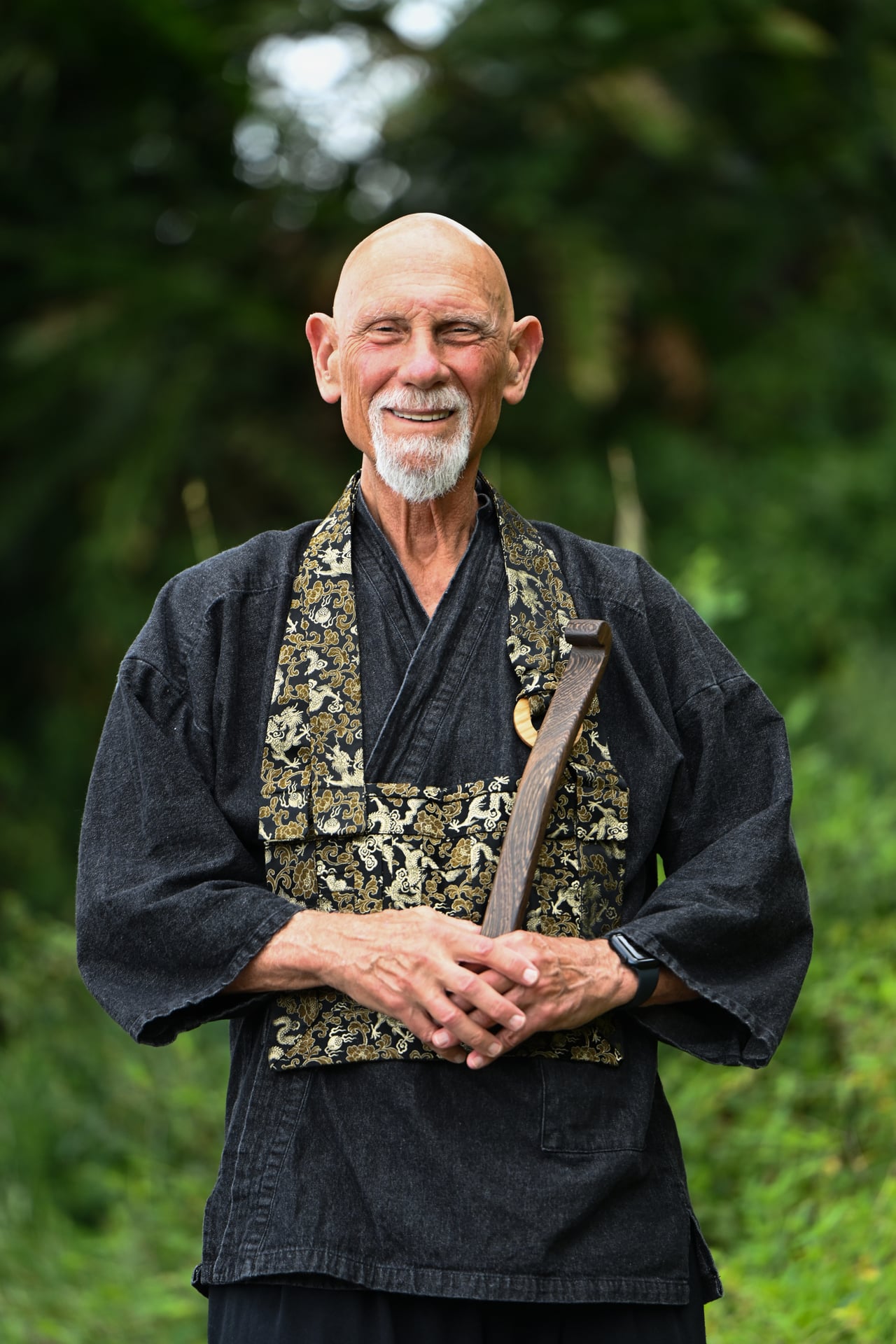
Genpo Roshi, Zen master and founder of the Big Mind process

From Brooklyn to the Dharma Seat

D. Genpo Merzel was born in Brooklyn, New York, in 1944. He trained at ZCLA – The Zen Center of Los Angeles from 1972 to 1984 under the guidance of Taizan Maezumi Roshi.

He received Shiho (Dharma Transmission) in 1980. In 1981, he traveled to Japan for further formal training and returned again in 1986, participating in a Tokubetsu Sesshin (special intensive retreat) conducted under the auspices of the Sōtō school. This training was part of an effort to ensure that Western successors were grounded in traditional Japanese Sōtō forms.

In 1991, a further gathering addressing succession and formal training took place at Maezumi Roshi’s original temple prior to his move to Zenshuji. The Sōtō headquarters provided sponsorship to enable Western successors to receive training aligned with traditional Japanese Sōtō standards.

Beginning in the early 1970s, Genpo Roshi’s work developed around three central intentions:

  • Bridging Zen with Western psychotherapy
  • Helping restore authentic Zen practice in China
  • Bringing renewed vitality to koan study, at his teacher’s encouragement

Deeply rooted in traditional training, he has also explored innovative forms of practice. His aim has been to preserve the essence of the Dharma while allowing its expression to remain alive in contemporary culture. Today, his teaching emphasizes integrity, maturity, and realization lived fully in ordinary human life.

Who Is Genpo Roshi

Genpo Roshi is a bridge-builder, someone who moves fluidly between worlds, perspectives, and ways of seeing. He does not fix himself in one identity but speaks from many positions, allowing others to see beyond their habitual viewpoint. His teaching is rooted in dialogue, in direct inquiry, and in the ability to hold paradox without needing to resolve it.

At his core, he is not a system-builder in the rigid sense, but a translator of experience — someone who takes what is often abstract or ineffable and makes it accessible, workable, and alive in real time. This is most clearly expressed in his development of dialogical methods of awakening, where different voices or aspects of self are given expression and integrated.

Emotionally, he is precise rather than sentimental. He values clarity, integrity, and structure, and is deeply attuned to subtle inconsistencies in people, teachings, and environments. This gives his work a sharpness and exactness, as well as a deep commitment to authenticity. Beneath this precision is a strong sensitivity that has matured over time into emotional containment and wisdom — appearing as steadiness, reliability, and a capacity to hold others without collapsing into their experience.

His life’s work has been that of a teacher and transmitter, not confined to one culture or tradition but extending across them. He has played a key role in bringing Eastern contemplative practices into Western contexts, reshaping and adapting them to function within modern psychological and relational frameworks. His mind is quick, agile, and capable of shifting perspectives rapidly, allowing him to guide others through complex inner landscapes — a rare capacity that forms the foundation of his teaching style.

At the same time, there is a grounded, embodied aspect to him: a valuing of physical presence, loyalty, and stability in close relationships. He is concerned not only with insight, but with how that insight is lived, felt, and integrated into everyday life. A central theme in his journey has been the evolution of authority — both embodying it and challenging it — through cycles of rise, difficulty, and reinvention.

Now, in the later stage of his life, his expression has become more distilled — less emphasis on expansion and more on depth; less on reaching widely, and more on working closely, carefully, and precisely with those who are truly committed. In essence, Genpo Roshi is a teacher of integration: one who reveals the multiplicity within the self, holds it with precision and compassion, and guides others toward a direct recognition of their true nature — while insisting that this realization be lived with clarity, integrity, and depth.

Studying with Genpo Roshi

As a student of Genpo Roshi who has been with him for nearly 20 years, I’ve had the privilege to witness this Zen Master’s ongoing, remarkable growth and transformation. His personal fall in 2011 was devastating, but I witnessed the courage it took for him to stay the course, steeped in the pain and suffering. He pointedly asked people not to coddle him or hurry his process along. To persevere with the painful process of self-evaluation, discovery, and then growth has been an unparalleled gift and teaching for those open enough to receive it. Genpo Roshi is a living example of one who does not rest on his laurels but continues to dive deep and transform again and again. — Kamie Buddemeier, MD

Stories of Transformation

The most powerful moment for me was when Roshi guided me to shift from anger to its opposite in just a split second—suddenly the anger was gone. This opened my eyes to the possibility of real change: to listen wholeheartedly, to step fully into another’s perspective, and to take responsibility. The retreat was heartwarming, spacious, and transformative—a true adventure that was both profound and fun.

Julia V.

A powerful experience of radical honesty and self-disclosure from both Roshi and the Sangha. It confirmed my own path of teaching with openness and vulnerability, helping me and others move deeper into self-acceptance. Something remarkable happens when you simply show up, question without judgment, and allow the process to unfold.

Paul J.

A magical experience—joyful, inspiring, and crystal clear. His presence was electrifying, blending wisdom, humor, and performance into an unforgettable experience that touched my heart and filled me with energy, love, and understanding.

Nina N.