
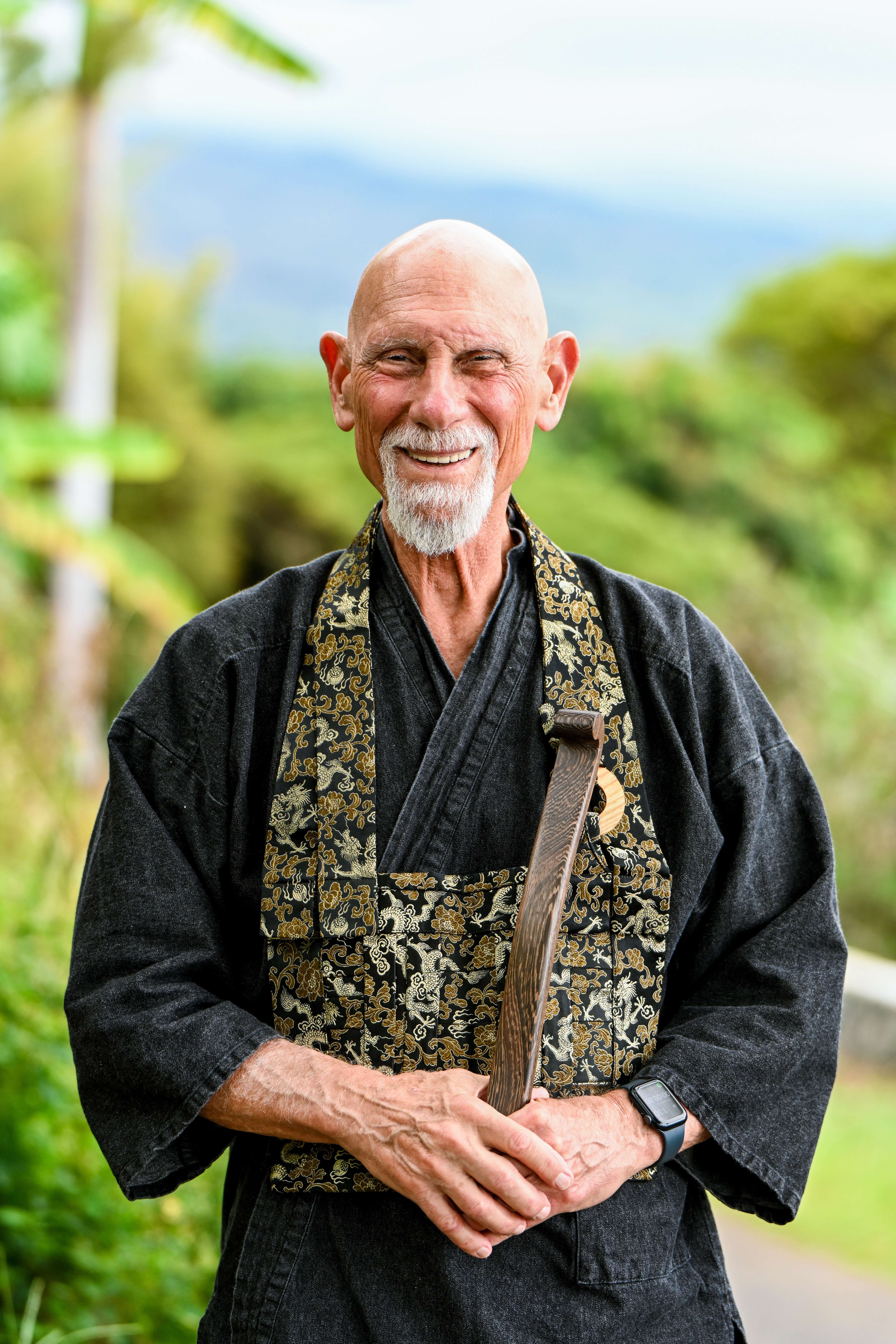
Meet D. Genpo Merzel
|  |
Studying with Genpo RoshiAs a student of Genpo Roshi who has been with him nearly 20 years, I’ve had the privilege to witness this Zen Master’s ongoing remarkable growth and transformation. His personal fall in 2011 was devastating but I witnessed the courage it took for him to stay the course, steeped in the pain and suffering. He pointedly asked people not to coddle him or hurry his process along. To persevere with the painful process of self evaluation, discovery and then growth has been an unparalleled gift and teaching for those open enough to receive it.
Genpo Roshi is a living example of one who does not rest on his laurels but continues to dive deep and transform again and again. Kamie Buddemeier MD |
Genpo Roshi's Upcoming Events
-
4 Jul 2026 • Online via Zoom
-
5 Jul 2026 9:00 AM • Online via Zoom
-
18 Jul 2026 • Online via Zoom
One on One with Genpo Roshi
Personal time with Genpo Roshi
15 Minute Personal Meeting
Donation: $125.00
Genpo Roshi is available Saturday and Sunday starting at 8:00 am and Wednesday 9:00 am Hawaii Time
To schedule or for more information please email Sabrina.
Genpo Roshi Now Blog
-
15 Apr 2024 9:00 AM
-
14 Apr 2024 9:00 AM
-
7 Apr 2024 10:00 AM
-
7 Apr 2024 9:00 AM
Who Is Genpo Roshi
Genpo Roshi is a bridge-builder — someone who moves fluidly between worlds, perspectives, and ways of seeing. He does not fix himself in one identity but instead speaks from many positions, allowing others to see beyond their habitual viewpoint. His teaching is rooted in dialogue, in direct inquiry, and in the ability to hold paradox without needing to resolve it.
At his core, he is not a system-builder in the rigid sense, but a translator of experience — someone who takes what is often abstract or ineffable and makes it accessible, workable, and alive in real time. This is most clearly expressed in his development of dialogical methods of awakening, where different voices or aspects of self are given expression and integrated.
Emotionally, he is precise rather than sentimental. He values clarity, integrity, and structure. He is deeply attuned to subtle inconsistencies — in people, in teachings, and in environments — and has little tolerance for what feels sloppy or unclear. This gives his work a sharpness and exactness, but also a deep commitment to authenticity.
There is a strong sensitivity beneath this precision — a guarded and protected depth that has matured over time into emotional containment and wisdom. Rather than expressing vulnerability outwardly in conventional ways, it appears as steadiness, reliability, and a capacity to hold others without collapsing into their experience.
To others, he often appears as a powerful presence — compassionate, spacious, and at times almost otherworldly. People tend to project onto him, to idealize or mythologize him, which has been both a strength and a challenge throughout his life. Learning to navigate projection, boundaries, and responsibility within relationships has been a central thread in his development.
His life’s work has been that of a teacher and transmitter — not confined to one culture or tradition, but extending across them. He has played a key role in bringing Eastern contemplative practices into Western contexts, reshaping and adapting them so they can function in modern psychological and relational frameworks.
His mind is quick, agile, and capable of shifting perspectives rapidly. He can enter into different viewpoints without losing his center, which allows him to guide others through complex inner landscapes. This capacity is rare and forms the foundation of his teaching style.
At the same time, there is a grounded, embodied aspect to him — a valuing of physical presence, loyalty, and stability in close relationships. He is not only concerned with insight, but with how that insight is lived, felt, and integrated into everyday life.
A central theme in his journey has been the evolution of authority — both embodying it and challenging it. He has gone through cycles of rise, difficulty, and reinvention, each time refining his understanding of what it means to teach, to lead, and to serve.
His work ultimately lives in the relational field — in the space between people — where identity can be examined, loosened, and transformed. He is particularly oriented toward working with projection, intimacy, and the dissolution of fixed self-concepts.
Now, in the later stage of his life, his expression has become more distilled. There is less emphasis on expansion and more on depth. Less on reaching widely, and more on working closely, carefully, and precisely with those who are truly committed.
He is no longer primarily a builder or promoter, but an elder teacher — one who embodies integration. His focus is on refinement, on preserving what is essential, and on transmitting it clearly within well-defined containers.
In essence: Genpo Roshi is a teacher of integration —one who reveals the multiplicity within the self, holds it with precision and compassion, and guides others toward a direct recognition of their true nature, while insisting that this realization be lived with clarity, integrity, and depth.